We drove to Punakha, retracing our path over the road during construction, and along the way, stopped at the Fertility Temple and learned about the Divine Madman who inspired it, walked a suspension bridge, and visited the Punakha Dzong, the main defensive fortress and scene of two clever defeats of the Tibetans.
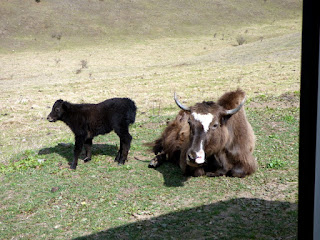 |
As we crossed the pass out of the Probjikha Valley, where
we had walked before, we found this yak and calf beside the road. |
 |
Above and below: sharing the road with big construction
equipment as well as other cars, trucks, and buses. |
 |
| Most of the trucks here are decorated like this one, |
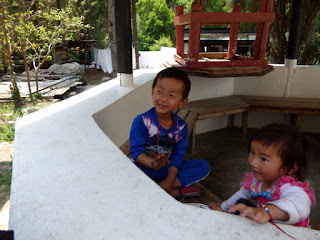 |
We made a pitstop at a hotel on the way and found these
children snacking in a gazebo. |
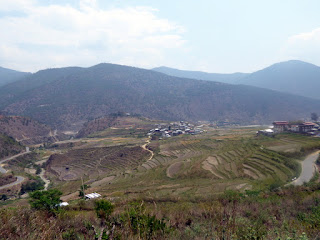 |
Looking down into the valley we will cross to get to the
Fertility Temple. |
|
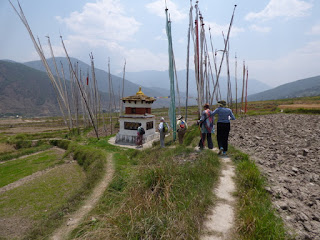 |
| Walking on the paths between the fields. |
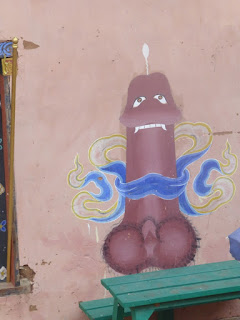 |
| Typical artwork here |
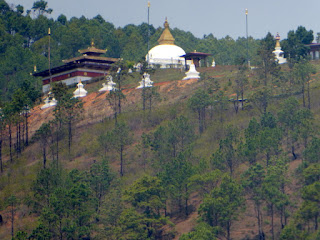 |
| The temple we are heading to. |
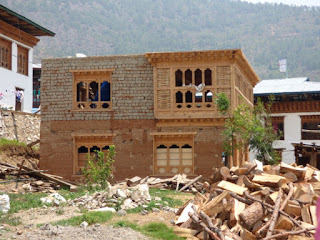 |
| A house under construction |
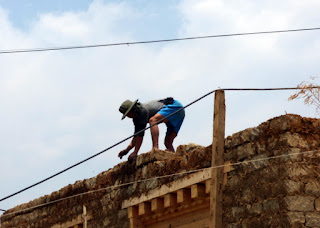 |
| The builder mortaring the adobe brick with mud by hand. |
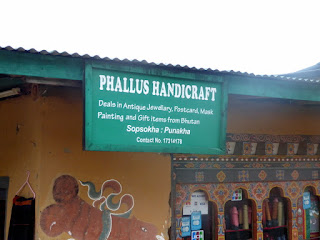 |
| This store sells the stuff in the window below. |
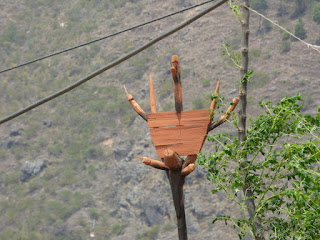 |
| More local artwork. |
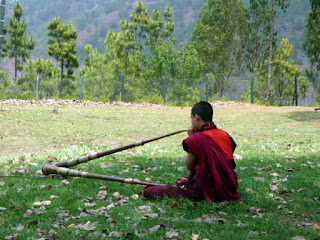 |
At the temple, young monks were practicing a variety of
instruments for their worship. |
The Devine Madman, (1455-1570) was a Buddhist master who personified 'Crazy Wisdom' by using unconventional and outrageous teaching methods. Monks are supposed to be celibate tee-totalers, but he indulged in alcohol, women, hunting, feasting, and song and dance. His intent was the taunt the established order, including the monastic order. The phallus as a flaming thunderbolt symbolized the discomfort society experiences when facing the truth. He was supposed to have tamed a number of demons who were tormenting the Bhutanese. This temple was built by his 'cousin brother' on top of the mound where he buried a much-feared demoness of Dochula.
We met the lama of the temple and were about to leave when a couple entered, seeking help conceiving. They had been here earlier, unsuccessfully, and it was said that the wife did not fully accept the prophecy, so they were trying again. She was given a large wooden phallus, the size of a 6 month old baby, and instructed to carry it around the exterior of the temple three times. When she came back in, she threw a set of dice which predicted her success and tried 3 times before the lama took charge, blessed them, and threw a number which indicated a baby could be conceived. Then she picked a scrap of paper from a sheaf of them and learned her baby's name (and therefore, sex), causing husband and wife to rejoice.
Chimi also told us her own story. After having 3 children followed by 2 miscarriages, her parents had come to this temple for help and got Chimi as a result.
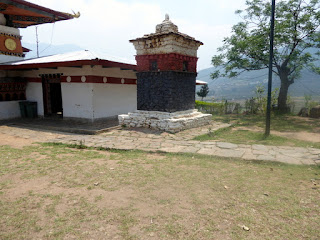 |
| The unusual thing about this stupa is the black paint. |
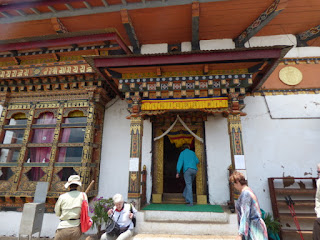 |
| Entrance to the Fertility Temple (Chime Lhakhang) |
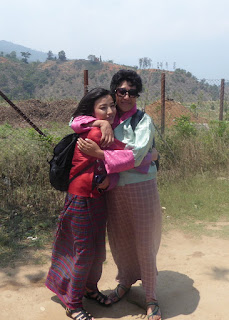 |
On our way back from the temple, Chimi
encountered her daughter, who is also a
tour guide, leading people to the temple, a
totally unexpected reunion. |
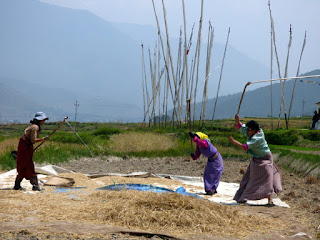 |
We saw two women beating wheat with ropes to separate the
chaff and Chimi enthusiastically joined them. As a farm girl
growing up, she finds she misses this king of activity. |
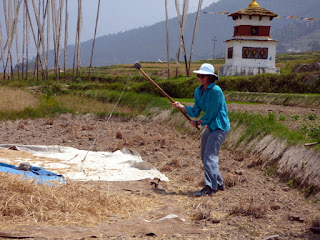 |
| A couple ladies from our group gave it a shot too -- this is Shelly. |
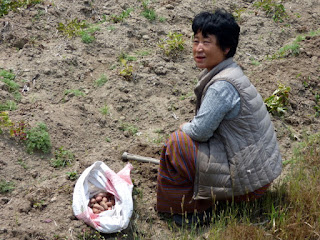 |
Next up was a potato farmer harvesting her crop. The altitude
is much lower here and the potatoes are further along that in
the valley we came from. |
 |
| View of Punakha Dzong on our way to the suspension bridge. |
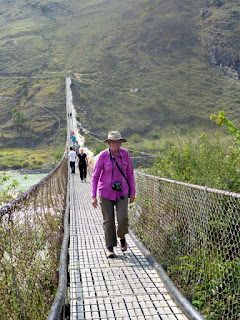 |
The worst part is going up at the end. However
this is undoubtedly the most stable of the
suspension foot bridges we have ever crossed
in Asia. |
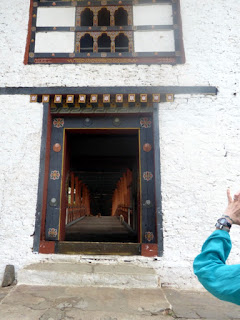 |
Entry to the wood bridge over the river that
leads to the Dzong. |
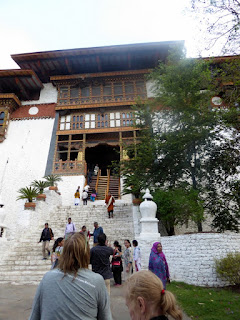 |
There are 3 set of wooden stairs here. There
has always been a pecking order of who can
go up which set. Now the outer two are for
everybody, except the royal family, which uses
the middle set. |
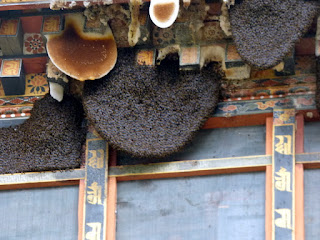 |
| The eaves of the entrance are a source of honey from these hives. |
This is the most impressive of the Bhutanese Dzongs, probably because Punakha was the country's capitol for a long time. It is situated where the mother and father rivers (Mo and Pho) join. It is also where all of the kings are crowned. It was established by Zhabdrung Rinpoche, the Founding Father, who coincidentally took an important Tibetan Buddhist statue when he left Tibet. The Tibetans tried several times to get it back, and brought a much larger force with them than the group defending the dzong, This dzong has an unusual feature, a back door not visible from the river. Zhabdrung had his soldiers march out the river-side door and around to the back, re-entering the dzong and going back out the front door, giving the impression of a much larger fighting force. The second time the Tibetans tried to recapture their statue, he gave the impression that he had heaved it into the river. Tibetans, like Bhutanese, rarely learn to swim because of the cold water temperatures, so they gave up and figured it was lost to both groups.
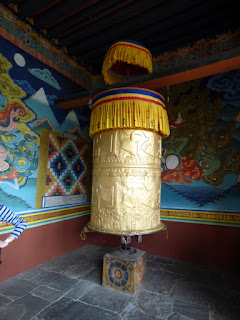 |
Prayer wheel at the entrance to the temple, which
was the biggest we saw here. I counted 48
supporting pillars, but most temples had fewer
than 10. |
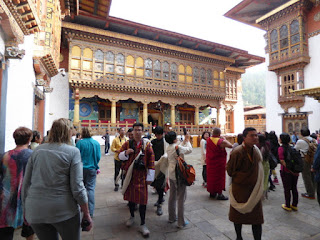 |
| An inner courtyard. |
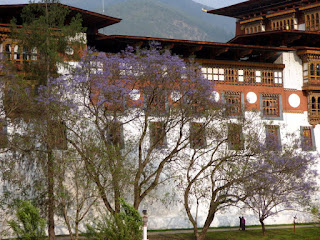 |
| Jacaranda trees at the front of the dzong. |


