Wednesday, June 14, 2017

6/14 -- Castelbuono, Cefalu, Mafia Discussion

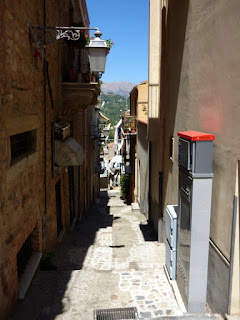
We headed east today, and stopped at a mountain town called Castelbuono. It had been important for a while, but now is mostly pretty, although it does have a castle we visited. The drive took us along the coast, and the waters of the sea were truly beautiful. On the way into the town, we passed a Sicilian cemetary, which is all above ground mausoleums, which are still being contructed. Most of them are owned by families, but there were also buildings  I called condos, which owned by various communities like a church or social group.

Interior

Some of these are huge- two stories

This section had a lot of modern design

Basic construction looks done but far from finished.

The community 'condo's: coffins were in many rows, with the
ends facing out, unlike most of the families, with the sides visible.
Before we started exploring the town, we got to taste a local delicacy called La Manna. It comes from ash trees, much like maple syrup, and is available in a nutella-like product with hazelnuts and La Manna. Jim liked the straight nuggets of it better than I did and we both thought the spreadable hazelnut product was okay, but we weren't tempted to buy any. We also tasted the cactus liquor again, this time cold, which was better, and limoncello, which was way too tart.

We hiked up to the castle and Isabella initially showed us into a closed room with a very short entry -- it had been used as prison cell for heretics, and the short entryway was designed to make them look like they were bowing to get in. Next was Sant Anna's chapel, another baroque work, followed by rooms with sacred art like vestments and gold jewelry donated to the chapel. There was also a wonderful view of the valley from this level.

Castle exterior
Prison cell
Chapel, above and below. The walls are colored
with gold.

Above and below: views of the city and countryside from
the castle.


This is a clearer view of
the puppets we saw yesterday,
displayed in the castle
museum.
Above and below, more views of the town.


Isabella told us that garbage here is collected
with donkeys and transferred to trucks for
disposal, because the streets are so small.
Unfortunately, we did not get to see them
because today was a regular day off.

From there,we had time to explore before lunch, which consisted of a lot of very fancy mushrooms that are generally pricier than black truffles and only found in this area.

Back on the bus, we went back west to a seaside resort town, Cefalu, which has a lot of rocky shore and one small beach. We saw lots of folks sunning and swimming in both settings and got to wade in the sea briefly. We also saw an ancient laundry. Rivers in Sicily are often routed underground to avoid flooding. In one such space, a laundry was created using the ice cold river water. The town is also known for its Norman cathedral, which we also visited.

Craggy rocks above Cefalu

The rocky beach

We were impressed by how clear the water is.

Entrance to the sandy beach.

Lynn getting toes and ankles wet. It
was lusciously cool on this hot day.

The river exiting the laundry area.

The water was channeled into separate basins with scrubbing rocks.
Brian graciously demonstrated the process for
those confused by the slanted rocks.

Exterior of the Norman cathedral

The wooden roof in the cathedral is unusual.

More of the rocky beach as we exit town.

A view of Cefalu from above.  One tower on the cathedral
represents the pope (on the left) and the other, the king. The
king's is slightly taller and the crenelations and domes are
different, one more crown-like, and the other with the pope's
hat shape.

At the hotel in the afternoon, we went searching for a snack and a watch band after mine had problems. This gave us an extra hour to walk in the 85+ degree heat. I am starting to remember how to deal with it, but it tends to make you think twice about walking in the sunshine.

We finished our day with a fascinating talk about the mafia from two men whose fathers had been conscripted into it at the age of 7 and made to leave school and start doing collections. They said the name and origination came from the time of all the raiders who came to Sicily and wanted to subjugate the people, who formed self-protection groups that the Arabs called mafia, meaning bold. These strong-arm groups eventually branched out into other areas but came to power in a serious way when Italy unified in the 1860s. Some time in there, they started calling themselves the Cosa Nostra, and had really never like the mafia label. Sicily at the time had lots of problems like rampant crime and the new government was wildly ineffective and turned to the mafia groups to bring order to the province and stepped back and let it happen. When things were under a semblance of control and the government wanted the mafia to step back so government could take over again, it was too late.

The next big growth time was in WWII when the Allies were getting ready to invade Italy and wanted a quick source of inside information, so they turned to the Cosa Nostra. There were efforts to rein in the lawlessness, and many mobsters in Italy were jailed. Two bold  judges took them to task, and were finally murdered. Drugs became a  major money maker and Rudy Guiliani in New York, as a young attorney was  looking for people in Italy he could rely on, and the two judges became his helpers. They were killed by Toto Riina, who was finally captured and convicted.

At that point, the father of one of the presenters became the big boss. He went into hiding for 43 years, taking his wife and two sons with him, but he prevented his sons from getting involved and that's why the son is now able to talk about his experience -- he knows nothing of the secrets, but has had a hard life because his father's wealth was confiscated and he is assumed to be a mobster by many. The other man's father had become a tailor and tried to win an important job by making free suits for the men in one of the main families, but was never accepted the way he wanted to be so there was less of a big deal about his son getting on with a normal life.

Tuesday, June 13, 2017

6/13 -- Another Day in Palermo

We got a short bus ride through Palermo past some of the sights within walking distance from our hotel. We learned that Palermo has been conquered by several groups, including Phoenicians, Moors, Normans, and Spanish (for 500 years, the longest occupation). As a result, the architectural styles are a mishmosh with several different styles possible on a single building.

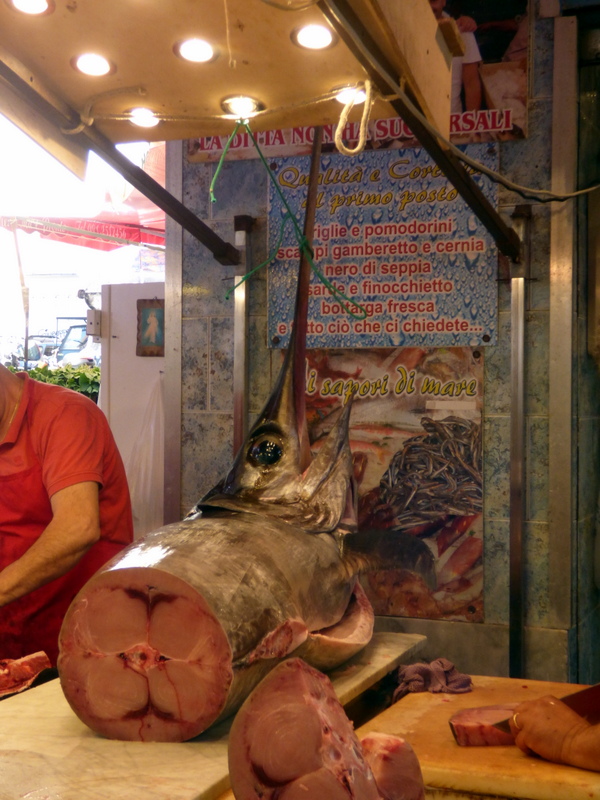
We left the bus to walk through a food market with Isabella, who bought us some goodies along the way. Although this was similar to many of the other markets we have seen, it was a first seeing a swordfish and a tuna being sectioned for sale. There were also VERY dinky strawberries -- quite sweet but too  mushy for most of us, so lots were left over. We also tried an alcoholic beverage made from a prickly pear cactus and a very rich macaroon-like cookie as well as a small sandwich cookie partially chocolate dipped with a strawberry cream center.

Start of the market

At 1.99 Euros per kilo, cherries here are about the same price
as in our Chinatown.

Interesting looking tomatoes

Swordfish

Tuna was 10 Euros per kilo

The long green things in the back are a variety of zucchini.

Fresh Octopus
As we approached something that looked more like a mosque than a church, we saw a bit of Roman wall and mosaic that had been excavated and covered to preserve it. It was there that we met our local guide, Laura, who was as funny as she was informative. She told us the big building was actually a cathedral, but had started out as a church which became a mosque and then returned to being a cathredral. Its style is a combination of Moorish and Norman influences, with the dark decorations made of lava from Mt. Etna.
Roman Ruins

Exterior of the cathedral, which has been added to several
times. The fancy entry, the lower exterior walls, and the
tower are all additions. The tower used to be a shorter, plainer
watch tower -- you can see just a bit of the walkway between
the cathedral and the tower on the left.
Across the street was an enormous boarding school, elementary through high school, that opened in the mid 1800s. It was notable because this was the school that the man who became the judge who tried to stop the mafia graduated from. We will learn more about this chapter of Sicilian history in a couple days. This church is actually THE cathedral of Palermo, and is rather plain inside. It also houses the body of a martyred priest who was stationed in the poorest section of Palermo and making inroads in the minds of the mafioso children to the point that the mafia decided they needed to take him out, though their general rule was not to mess with children, women, or priests.

Cathedral interior
It also houses the patron saint of Palermo, Rosalia. She is the fifth patron of Palermo, and replaced the preceding one because she got credit for saving the city from the plague when the previous saints were ineffective. She was born noble and chose to give up wealth and live as a hermit in a cave where she died alone in 1166, When the plague came to Palermo in 1624, she appeared in a vision asking to be found and brought to the city. When that was done, the plague ended.

Rosalia chapel -- all in sterling silver. Her bones in a silver
box are paraded around town every year.
The last thing we looked at inside was a meridian in bronze on the floor with various astrological symbols set in marble along its length. It marks the 38th parallel and there is a window positioned to shine light on the meridian in such a way that the astrological  markings match up with the time of the year.
The meridian with the astrological signs for Jim and me.
We took a rest break at a coffee shop -- Jim and I shared a wonderful raspberry sorbet -- before continuing our tour of a baroque cathedral, that started as early baroque (highly decorated but not totally) and ended up as late baroque (much more intensely decorated but not totally over the top like rococo). Laura explained that much of the design of the church was to counter Martin Luther's radical ideas about simplification and direct connection to God without a priest. The pulpit moved to the center of the sanctuary so everyone could hear the sermon, there were bunches of confessionals all around, and decorative elements became more important.

Early Baroque interior

Late Baroque chapel above and altar ceiling
below

Laura also promised to tell us about the last confession she gave once we left the church. She and her brother enjoyed visiting a variety of churches instead of just one and went to church around Easter. Since confession should be done at  least once a year, preferably around Easter, they decided it was time. There were long lines at every confessional but one, so they went there. Her brother, being a gentleman, let her go first. The priest, however, was nearly deaf, so whatever she said, he repeated loudly ("I haven't been to confession for a year." "YOU HAVEN'T BEEN TO CONFESSION FOR A YEAR?") When she managed to escape, her brother confirmed her fears that everyone one in the area had heard her words repeated.

We walked to the 'Fountain of Shame' (officially Pretoria Fountain) which is being renovated, and finally to another church with a variety of styles. The fountain was built in and for Florence, but they decided they didn't want it and sold it to Palermo. It was so large, there was only one square big enough to hold it, which happened to be bordered by a nunnery. The rampant nudity combined with its location led to its unofficial name.

Fontana Pretoria, the Fountain of Shame
Norman on the left, Baroque in middle, Moorish on the right
Laura left us and Isabella offered an option to meet a puppet master, an entertainment style that is dying. Giacomo had puppets galore lining his walls. They were bigger than the marionettes on a string, and had a combination of metal and stout string pulls, which gave them amazing movement options. We learned about some of the makings of a puppet and his family's involvement in puppetry for the  last 6 generations. Puppetry used to be opera for the masses and was offered daily, often telling a long serialized story. Each 'chapter' might take 3 hours (they are down to one hour now) and they could go on for months. Currently shows are held weekly and this company travels all over the world, and has been to San Francisco.

If you look closely, you can see a metal rod in each head and
attached to each right hand.
Giacomo with a marionette
Heads are interchangeable and this one has 3 sides, to represent
different aspects of the character.
Based on our interest level, Giacomo took us into the theater and demonstrated how puppets were worked -- at least two puppeteers work together and hand off the puppets as they cross the stage. There was also a hand-cranked mini player piano that supplied the music and is typically run by an apprentice, who from his position, can  look up into the works and see how the puppeteers manage their display. We were further invited into the workshop (no photos) where puppets are carved, painted, and clothed. Because these puppets are so large and heavy and sometimes people want souvenirs, they have a light weight smaller style, which is similar to the smaller ones that children learning the art are given to practice with.
The theater holds about 100 people.
Scenes from 'chapters', sort of like movie trailers

Giacomo next to the stage with the curtain closed.

With the main curtain open, there are four layers of background
available to use. All were painted by Giacomo's grandmother.

Giacomo behind the stage framing lifts it up so we can see
where he works the puppets.


Knight puppet in action

The mini piano player with hand crank.

Then we had a choice of lunch or exploring or hotel. The heat here is something to adapt to and I am not there yet, plus I was full from all the noshing, so we took a break to cool off and work on the blog.

We went back out with the group to visit a new Grand Circle Foundation location called  Orotorio Santa Chiama. Sicily gets a lot of refuges fleeing through North Africa, and this is one of many non-profits working to support their transition to Europe. This is run by three priests, provides a low-cost kindergarten from 7:30 am to 5:30 pm and student activities during non-school hours from 7:30am to 7:30 pm. We got a chance to learn about the project and then to see some of the kids involved with the program.


Before we left, we were taken to an unused portion of the building that was excavated to reveal part of the original Phoenician walls, dating back to 750 BCE. It looked like the room had been an auditorium, and there were interesting paintings on the stage opening too.We also visited the original baroque church which is sadly falling into disrepair.
The Phoenician walls below with the stage
front behind.


Above and below, apparent frescos on the stage front
 

The center's church, Santa Chaimo

Then it was on to a typical street food Sicilian dinner -- deep fried rice balls with meat or vegetables inside, some sort of thin, light fry bread and dinky pieces of tomato pizza on a fuffy thick crust with honeydew melon for dessert. The rice balls were huge and very filling but the other 2 hot items tasted better.

Monday, June 12, 2017

6/12 -- Palermo

We slept til almost 8 and went to breakfast and had a nice chat with the host til almost 10am. Check out time was 11, but we were in no hurry to get to the next place because it was unlikely our room would be ready, so we dawdled til almost 11 and saw the group with the Green Bay hat guy checking out just ahead of us.

Our new hotel was only 2 minutes away on foot, so we hustled over there and met Isabella, our tour leader for the next two weeks. As we were talking to her,  the four folks in the Green Bay hat group walked in -- they are on the same tour! Talk about a small world. Just as we were getting ready for an orientation walk, another OAT traveler showed up. Our rooms were not ready, so we  left our bags and Isabella showed us where to find some of the things we discovered on our own, plus an ATM, stamp source, and a couple gelato shops where the gelato is served inside a warm sweet bun.
 A building on our walk.  I liked
the door (above), Jim preferred the
whole thing (below).

This looked to us like a single building that had been lopped
in half.
Back at the hotel, the rooms were ready, so we checked in and quickly crashed -- a two-hour nap helped rid us of the lingering jet lag. We went walking again, going further into the old city and stopped for a gelato, but opted for a waffle cup instead of a bun.Then we walked out to the harbor before coming back to the hotel to meet the rest of our group and getting an intro to our trip and dinner.
Presumably because of the  heat here,
this is how people protect their homes
from the sun. Note how delapidated
the door is.

Typical narrow street

Blue suede shoes available cheap.

Or maybe some sparkley sandals for me.

Church of San Francisco of Assisi

Huge cruise ship  leaving. We saw it go by as we walked|
on the street --  it looked like a giant bulding floating by,


A headland on the other side of the harbor that leads to mountains.

The other side of the divided builing. The front middle sections
were added later- different materials.  Maybe it was originally
connected as a gate.

The church around the corner from our original
hotel.

Sunday, June 11, 2017

6/10 & 11 -- On to Sicily & White Hair Advantage???

We flew out on KLM to start our trek to Sicily on Saturday afternoon. We had noted that our boarding passes, printed at home, did not say TSA Pre, even though we had paid for that clearance. At the airport, we asked KLM staff and they said neither KLM or Air France had decided to participate in the program, so we were out of luck, despite our official enrollment. TSA staff confirmed that TSA Pre needed to be printed on our boarding passes and our known traveler ids didn't help. So I was pretty bummed. It is so much easier to not have to remove shoes, jackets, toilettries, and electronics and to go thru the metal detector instead of the scanner! Fortunately, the normal line was so fast, I didn't have time for any prep before we were being waved on into the metal detector -- I asked about shoes and  jacket, and the agent said they were ok, and after I got through, I realized Jim had not been asked to remove the liquids and computer from his bag either -- just like Pre! And it got me to wondering if my now silver hair makes us look 75 or older,  which is the age clip level for an easier path through security. If so, it is the first notable advantage of going natural!

Our plane left San Francisco about 25 minutes late, but we had such a great tailwind, that we got to Amsterdam almost 30 minutes early. We tracked our speed as being in the high 600s and low 700s for most of the trip.  It took 2 plane changes to get to Palermo and we were really lucky that the tightest time for a change was to a flight literally across the aisle from where we came in.

We got to our B&B before 5pm on Sunday (9 hours ahead of San Francisco) and discovered that it was not a stand-alone establishment but self-contained on the 3rd floor of a 5-6 floor pallazo. Lucky we are used to steps! After a couple hours to regroup, we wandered out to find our hotel for tomorrow (we flew in a day early because our original flights had us missing most of the first day's events and the OAT hotel was totally booked) and look for dinner.

On the way out, we met a group of four coming in, one of whom was wearing a Green Bay Packer hat, so of course, I complimented him on it. Like the rest of the Mediterranean, Sicilians are inclined to think of 9pm as the start of dinner, but we found a little place with charming people and good cheap food and wine -- 6 Euros for a half liter of a credible red wine and 20 Euros total for dinner plus tip. Maybe we won't bread the bank on food here!

The city inself is a blend of old and new and we are staying in the old center. Tomorrow we will get to learn more about what we were looking at today!
Typical Palermo Street. This is Via Vittorio, one of the main
thoroughfares in the old part of the city.