Mazara is a lovely fishing village with a singular claim to fame: in 1998, a trawling fishing boat snagged a 200 pound ancient Greek statue that may date back to the 3rd or 4th century BCE. It also was originally settled by Tunisians before the Phoenicians arrived in the 9th century BCE. Since then, it has seen a lot of different populations immigrating and is now a fine example of Muslims and Christians co-existing peacefully in close proximity.
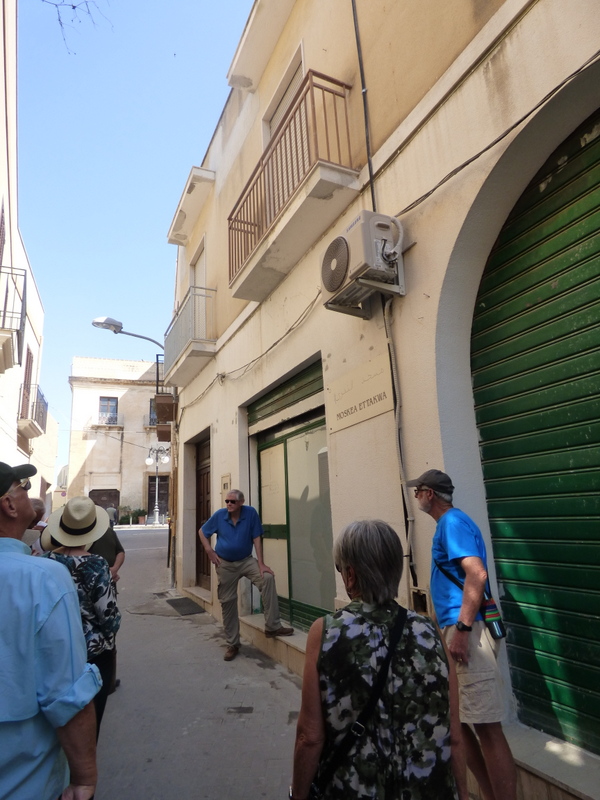
Before we went to see the statue, however, we met Antonio, a retired banker who now leads tours for free. We started out at the last remnant of their Norman castle, and walked to the cathedral, which is reputed to be decorated with a thousand angels. It is not open til later in the day, so we will have to come back to see them. Next, we walked to the original Tunisian area called the Kasbah. It was abandoned and fell into disrepair until Tunisians started coming back to Mazara and rejuvenated the Kasbah, along with a collection of Christians. Now there are mosques and churches next to each other, and the mosques have eliminated the public calls to prayer that are early and late to accommodate their non-Muslim neighbors.
 |
| The remains of the Norman castle |
 |
| The front of the cathedral of the angels |
 |
Detail over the cathedral door showing Count Roger defeating
and Arab. |
 |
We thought the streets were pretty narrow til
we saw the one below. |
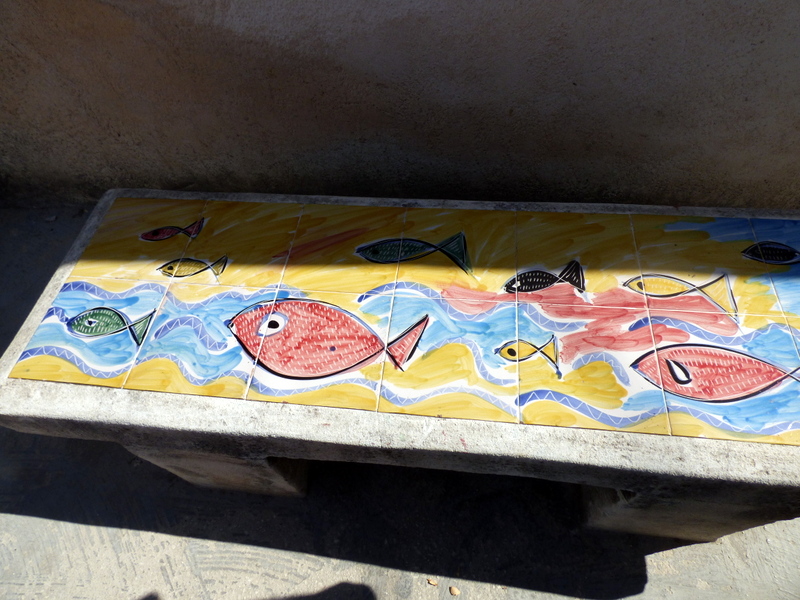
Another thing that has helped the Kasbah is the mayor, who is in his second term.Some find him arrogant, but his love of art and personal interest in ceramics has made for a collection of art in the Kasbah that is inspirational. He wants each small alleyway to tell a story, and already, many do. The Kasbah was built with narrow streets to limit the amount of sunshine on each building, keeping them cooler. He also instigated a project to have decorative pots all over, some of which are his, and many more were done by other artists. Another project was a contest to paint the rolling doors that protected the ground level shops and the resulting murals reminded me a lot of the murals painted in the San Francisco Mission district.
 |
| Many of the alleys now have tiles on the street. |
 |
| Contrast between the old (upper part of photo) and new |
 |
| Tiled bench |
 |
| Antonio with one of the mayor's vases |
 |
Via Magdelena tells the story of the bad tides (malrobbio).
A couple times of year, there is a sort of tsunami in the harbor
with 6 foot waves. Boats that are not secured are damaged.
The tile projects below tell the story. |
 |
This is one of the store shutter murals. I will
post more of them on Facebook. |
 |
This mural won the contest. We thought others
were better, but this was more emotional. |
 |
| A mosque |
 |
| Around the corner, a church |
 |
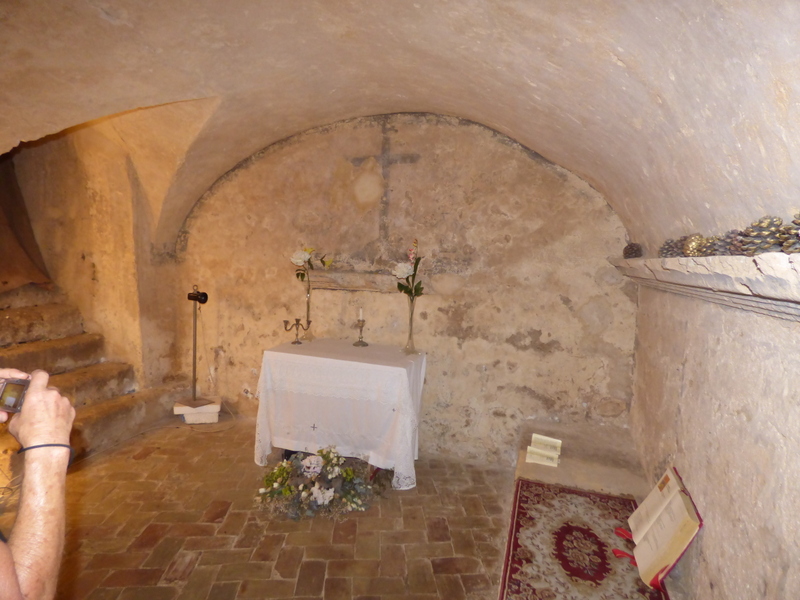
Inside of the church.. There was a funeral in
progress, but we were invited to go in and see
the crypt (2 photos below). |
As we walked along, Isabella spied an older woman on her balcony and called up to her to ask what she was doing, and she said 'cooking' so Isabella asked when lunch would be ready for us to much laughter. As we were talking to the first lady, another came out on a neighboring balcony and got the same treatment. When we walked away, Isabella told us about a cartoon she had seen that she thought was hysterical. It was divided into two parts: The one labeled "photo surveillance in North Italy" which showed a bunch of cameras; the other was labeled "photo surveillance in Sicily" and showed old ladies out on their balconies.
 |
Above and below: a ruined church from long ago, interesting
because of its oval shape. |
 |
| Detail over one of the arches of the ruined church. |
After our walk through the wonders of the Kasbah, we went to the Museo del Satiro -- the Museum of the Satyr, the bronze statue found by the fishing boat. We started with a 20 minute movie about what happened -- a local boat was trawling about 20 miles off Tunisa and captured a bronze leg from knee to foot in their nets.This was a huge discovery and an American sub team set out to find the rest. The Sicilians had to identify the general area of the find, but they knew if somebody else found the rest, the statue would be lost to Italy forever, so they concentrated on fishing in this ares, which happened to be a good place for fish, and in 1998, 8 months after the original find, they pulled up the main body of the statue, which was covered with mud. They cleaned it the best they could and sent it to Rome for conservation, which was time-consuming and pain staking. When it was restored, it was returned to Mazara and installed in a former church. The best guess about where it came from was either that it was being shipped somewhere for display, or it was being returned to Greece to be melted down for another project. The ears identify it as a satyr, and the dance-like positioning of the body suggests a figure in a dance-caused trance, much like that of whirling dervishes.
 |
| The dancing satyr |
 |
| The shape of the ear identifies this as a satyr |
 |
| Back of the statue |
 |
| Small plaster image of the second discovery |
 |
| The statue under the dome of the former church. |
Then we went to the Garibaldi Theater, a theater for regular people (there is no 'royal' box), which was built in 1848 primarily by boat builders, The theater closed 100 years later and at the instigation of the mayor, opened again 7 years ago. It now puts on 16 plays a year, but the seating capacity is limited by safety concerns. Antonio then surprised us with a performance of Volare and New York New York and proved himself an excellent singer as well as a story teller. Then Isabella was joined on stage by one of the crew of the ship that found the satyr and we got to ask him questions about the experience. Our theater sojourn was completed when Antonio sang O Sole Mio. It turns out that he works as a singer in a piano bar! We went to his gift s hop nearby to get a map of the area for our independent explorations (and many of us found goodies to take home), and then we went to lunch.
 |
| Antonio serenading us |
 |
| The ceiling of the theater is shaped a lot like the stern of a boat. |
 |
Two levels of boxes, but only the lower level is considered
safe now. |
 |
Isabella and Francesco, one of the boat crew who found the
satyr statue. |
After lunch, we headed back to the hotel for a couple hours and Jim and I checked out the lovely pool. It was very refreshing, but my swimming skills are BADLY out of date and I couldn't do a single lap except on my back.
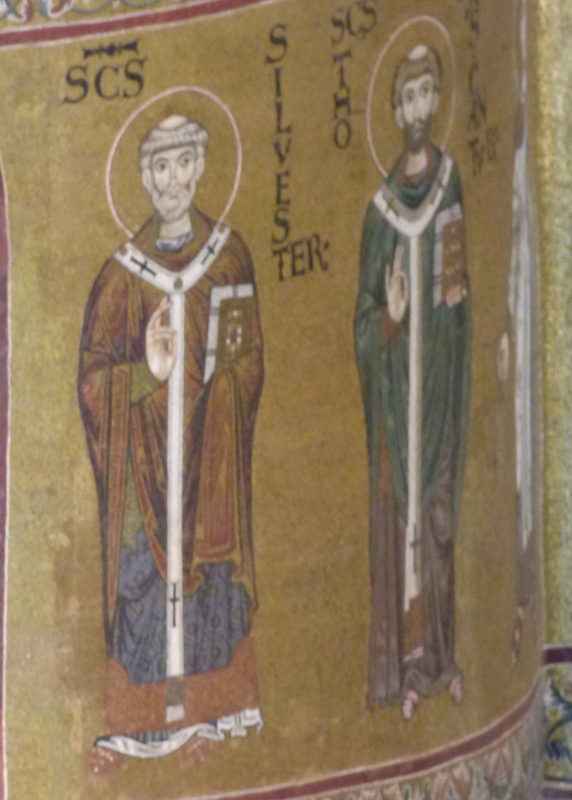
At 5pm, we headed back to Mazara to explore on our own and got to see the inside of the cathedral, though we nearly missed it as we arrived just as a wedding was ending and we had to wait for the end of the ceremony. Then Jim and I headed back to the Kasbah hoping to see new stuff, but got lost, even with the map, on the twisty streets and barely made it back to the square in time to go to our cooking lesson. Usually, OAT cooking lessons involve watching people work, but not this time. We were divided into 5 groups and each made a dish for dinner. I volunteered to make pasta because I had watched it twice in Tuscany, and actually wanted to try it. We worked well, and our instructor was surprised we were so successful. So maybe I will actually try this at home instead of just thinking about it!
 |
Above and below: Interior of the
cathedral with the horseman
over the entrance. |
Once dinner was over, it was back to the hotel to prep for tomorrow.


 As we walked along, Isabella spied an older woman on her balcony and called up to her to ask what she was doing, and she said 'cooking' so Isabella asked when lunch would be ready for us to much laughter. As we were talking to the first lady, another came out on a neighboring balcony and got the same treatment. When we walked away, Isabella told us about a cartoon she had seen that she thought was hysterical. It was divided into two parts: The one labeled "photo surveillance in North Italy" which showed a bunch of cameras; the other was labeled "photo surveillance in Sicily" and showed old ladies out on their balconies.