Sunday, June 17, 2018

6/12 -- Boating for Birds

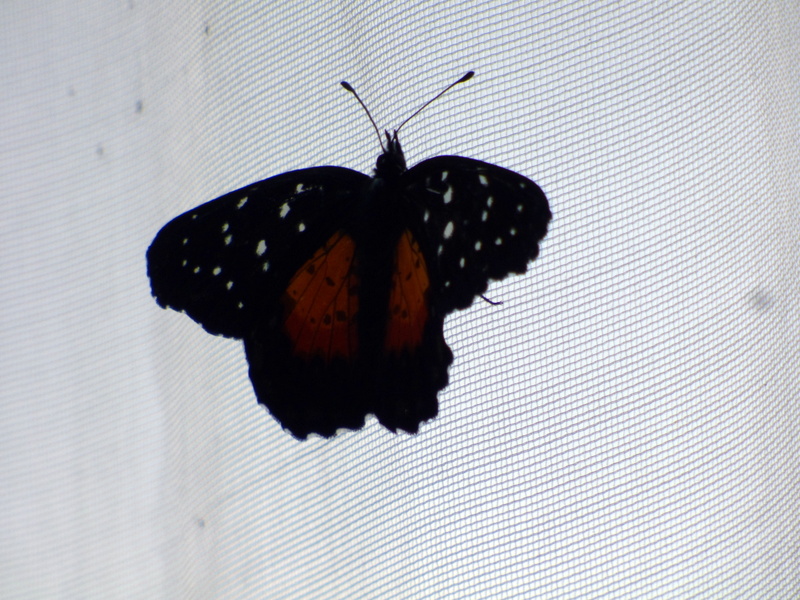
Jim spotted this little guy as we walked to breakfast at the hotel.
We drove to Los Chiles, very close to the Nicaraguan border and embarked on a boat ride to see birds and other aquatic life. The river is part of a biological corridor that is being created across the country to allow the wild animals to traverse their traditional territories without having to brave human intervention. The river corridors started out narrow and are gradually being widened, though we saw some narrow areas on our ride.

Crocodile

Basilisk lizard

Howler Monkeys


Basilisk

Heron?

Most of the cattle here seem to be brahmans

Another lizard -- generally easier to see and photograph than
some of the birds.

When we neared the border, we had hoped to get a picture of us by the "Welcome to Nicaragua" sign, but another big boat with LOTS more passengers hogged the location. We briefly entered Nicaragua as the boat turned around.
The border!
The river and our boat

Green Heron

Eleanor is holding an interesting flower: Andres plucked the
sheath on left from a tree and pulled out the flower on the right.

Iguana

Bats! These sleep on a tree. VERY tiny.

Ducks left, jicana right


more ducks

Another heron

Heron?

Flying Egret

A raptor
After the boat ride, we had a lunch that will help with my weight loss program and then drove to the home of a family who has made a successful business out of preparing and selling papaya root for a traditional picadello, used for celebrations. The husband had been a pineapple farmer and was physically no longer able to do the work. He and his family saw prepping the papaya root as a valuable service because it was so time intensive. But he was also an inventor and developed a number of tools to speed the process. His wife showed us around and gave us a chance to help with some of the work.

The whitish things are papaya -- called roots,
they are also the base of the tree, which are
replaced every two years. The long handled
tool in the front is used to skin the bark off
the tree.

This is the grinder, which was hand punched with several
different shapes. The papaya root is sent from outside to inside
with in a big tube and lands on the platform behind. When
the grinder is running, it is covered with a metal box and the
grindings fall into a big plastic bin below. I tried feeding the
grinder -- you would develop some muscles doing this.

The bucket is unloaded onto this screen and pushed through,
capturing the harder and larger chunks which are discarded.
The grid is removed and the ground root is packed into 2
kilo plastic bags. I helped with this step and also bagged
and got the right weight on the first try.
Afterwards, we had the opportunity to sample the picadillo made from the root. Another weight loss product for me....

6/11 -- Getting to know you


Today was designed to immerse us in the lives of the local people. We drove to Sonafluca in the lowlands to visit a school and have lunch with a family. We started out at a grocery store where each person or couple was given an item to locate -- in Spanish of course. Some of them were easy for Google Translate, but the dessert was a challenge because it was a takeoff on the Spanish for guava, and not in the dictionary. In the grocery parking lot, Andres spotted a sloth in a tree and focused his long-range view finder on it. We each looked, and then he used our cell phones and the viewfinder  to capture a picture and a short video of the sloth scratching.
Upside down sloth

We also got a view through the clouds of Mt Arenal, the
local volcano.
 In Sonafluca before we visited the school, we walked around the village and stopped at a tiny grocery store. This is where you can find just about everything from groceries to hardware. The stores are too small to enter, so you shop by asking for what you need. Most people got an ice cream bar.

While there, we encountered a lady who wanted to show us her organic gardens. Her daughter was the primary farmer and was hosting one of the twice yearly seminars for a college on how to convert to organic. Some people were working on a section of the field, but most were watching. One of the watchers was a doctor who had spent  time in the US and spoke excellent English. He filled us in on the reasons for this transformation. Costa Rica hopes to become the first carbon neutral country in the world, and is well on their way.
Doctor (in green) explaining the seminar's intent

Orchids in the town. There are many that we have seen here.

At the  school, we were met by a cadre of girls and boys in traditional dress who 'adopted' us and led us to an area where they showed us several tradition dances. We were invited to join them for the last one which reminded us of musical chairs -- when the music stopped, you had to find another dance partner and the loser dances with a broom in the middle.  The principal joined us and took us on a tour to see what kind of improvements they have been able to  make over the last 8 years that they have been helped  by the Grand Circle Foundation (the non-profit arm of our tour company). The girl who had collected us at the gate very jealously guarded her relationship with us and made sure she was our guide through the school.

Next we headed to lunch at a local home, bringing the foods we had collected. One of my favorite dishes was the green bean, carrot and meat picadillo. 
A bird at the home

Kitchen (right) and dining area of the home
On the way back, we saw this man pulling
yucca (casaba) roots, which had been thinly
sliced and deep fried at lunch -- totally delicious!

A kind of a weaver bird next to the top of the nest.

When we got back to El Toucano, Andres led us on a  walk on the grounds.
An itty bitty frog

Another orchid


Tuesday, June 12, 2018

6/10 -- We Meet the Group and Set Out


 I often joke that I should travel to places where I don't like the food to lose weight and breakfast seemed like maybe I had found a way to take off 10 pounds. We drove to Alajuela and walked around, tasting several interesting fruits and taking in part of a Sunday concert in the park. 
Bright Blue house off the square

Sunday concert

Primary Catholic church of Alajuela

Back in the bus, we headed to a coffee plantation near one of the volcanoes. Before the tour started, we had time to explore a butterfly garden, which was really special. 


We learned about how coffee is grown, harvested, and processed. I found it interesting that while coffee trees can live 100 years, they are only considered productive for up to 25. We sampled and bought a bag of coffee and had lunch at the plantation.
Green Coffee Berries -- Ripe when they are red

Picking basket -- fills the little metal basket below about twice
Red baskets -- small and larger -- measure how many berries
fall into the pit below. Better berries are heavier and sink when
the pit is filled with water. Berries are suctioned from the bottom
and graded by weight and size.

Next we headed for the hotel. This is the rainy season, and it is normally pretty nice in the morning and wet in the afternoon. Today was no exception -- started to sprinkle around noon and quickly became a downpour then lightened up. This pattern repeated several time through dinner. We had raincoats with us, but had left our rain pants behind, to our sorrow. We stopped at a waterfall and our legs got totally drenched trying to take photos. A little later, we stopped at a restaurant for a bio break and snack and tried to photograph the hummingbirds flitting around the  feeders.


Our hotel, El Toucano, near Quesada, has thermal pools fed by hot springs and some of our group enjoyed them but I have never been a fan of soaking in a hot tub while getting rained on. The OAT literature says Costa Rica gets 9 inches of rain in June, but it felt like we got 2-3 today with no end in sight. We also found lunch and dinner to be quite tasty, so my weight loss program may be in peril. I thought the typical diet of rice (ok) and beans (yuk) and plantains(??) would not be that palatable, but the salads and chicken dishes have been great.

6/9 - Fly to Costa Rica: Horrible Start!


Checking a bag at American after checking in online was confusing and challenging. Signage was minimal, but the new process is to proceed to a kiosk to print out and apply your own baggage tag before getting in the long line to turn the bag over. Several kiosks were out of service, the passport reader refused to accept my passport so I had to type it all in using a screen where the calibration was so bad that LYNN came out LYJH -- I had to almost miss the N to get it to read. Then they wanted payment for our checked bag, very unusual for an international trip (they told us international free bags only counted if we crossed an ocean...). While I was fighting the machine, Jim was managing 2 roller bags, a heavy backpack and soft carryon, and got tripped up, hurting his left shin and knee.

TSA Pre was loaded with slow people, but we had arrived early and stopped to get breakfast. I couldn't remember if I had put away my credit card after the bag fee and mis-read what I had in my wallet, so went racing back out of the secured area to see if my card  had been turned in (no) and going back thru TSA Pre was even worse because half the staff was on break -- 2 sets of lines the first time, now one. I was supposed to meet Jim at the gate in Terminal 2, but our gate was NOT in terminal 2 and American was not helpful telling me to go to Terminal 1 because they didn't mention the connecting corridor and I was thinking I had to leave security again AND I couldn't find Jim and he did not bring his phone. I was frantic and  near tears and boarding was due to start when TSA pointed me to the short cut.

The rest of the trip was pretty uneventful, but the start was brutal. Our trip leader in Costa Rica led me to a pharmacy where I bought a knee brace for Jim, hoping it would help his mobility.