Tuesday, April 16, 2024

4/16: Visit Gozo, Second Largest Island in the Archipeligo

We were due to leave at 7:45 am to catch a ferry on the north side of Malta and we are on the south side. I set my fitbit to wake me at 5:50 but it kept wanting to be at 4:50. When I finally moved it to 5, I didn't realize I also bumped the PM button.....fortunately, I woke normally at 6:45, which didn't give me as much time as I hoped for. I was grateful that I had picked out my wardrobe and packed my daypack last night or I might not have had time for any breakfast at all.

Traffic north was worse than usual and we missed our 8:30 ferry by about 5 minutes, but there was another at 9, so we were still good. There was rain in the day's forecast, so some adjustments were made to keep us indoors more. As it turned out, we only got sprinkled on once briefly but enjoyed the reconfigured schedule.

Gozo is described as being like Malta 30 years ago. It seems to be more agrarian and greener too. It's main claim to fame is its neolithic temples

 that date to before the Egyptian pyramids. We were able to visit one of them today, called Ggantija.  Afterwards, we visited "Calypso Cave" and a bakery with a typical roll with a slice of cheese. They also had an impressive selection of desserts, which I managed to only photograph and not eat. 

After the temple, our bus driver had to drop us off so he could make a school bus run, so we just under an hour to shop in the center of Victoria, the capitol of the island. I walked up to see the Citadel and still managed to pick up some souvenirs. The bus took us to lunch and then to a salt producer, smaller than the other producers we have visited. Then it was back to the ferry for the trip home.


This fragment was found in 1954. Its bird
decorations show how nature inspired the
Neolithic inhabitants.

These stylized figures were found in a temple
presumably wrapped together in material that
didn't survive for 6000 years.

This depiction of 2 women is typical of the carvings of
people. They all have wide hips and pleated skirts, and
most are missing their heads,

These 2 heads were found completely separate from
other figures. There is no conjecture about why they
were not kept intact.

These are the 2 temple that exist side by side.
The theory about the extra room on the left one
is that it was for VIPs like priests. Conservation
is currently being done on that one, so we were
only able to enter the 1st section.


One myth about how the temples were built was
that a giantess carried the stones while nursing
her baby and eating broad beans. In truth,
archeologists think they used large round rocks
to roll the slabs into place. How they were
raised was not presented.


The slab on the other side of the entrance
also has a hole, presumbly enabling
some sort of a gate.


These are presumed to be the rocks used to move the stones.

 The items below are the colorful and some very tempting looking sweets.


The next two pictures are from the Calypso Cave viewpoint, which only looks out on Ramla Bay (the sand is reddish due to ocher coloring in the near by soil). Nice view. The sign says the viewing platform is NEAR Calypso Cave, which I suspect is the area in the second photo. According to Homer, the nymph Calypso lived here and is where she hosted Ulysses for 7 years before he continued his journey home. The cave is a series of caves and goes down to the sea.


A shop in Victoria with interesting art.

The entry side of the Citadel

View from the parking lot in the back

A area popular with divers next to the salt pans

These individual pans extend quite a way and are managed
by a single man.

The sandstone around the entry to the salt shop and storage
area looks kind of like a hardened dune.

The salt man in his shop.

4/15: Explore Valletta

 We set out for a walking tour of Valletta and I free-lanced in the afternoon, walking to the end of the peninsula to visit Fort St. Elmo and the National War Museum. Then I walked back to the hotel and out to dinner, accumulating over 18,000 steps for the day. I needed a nap before dinner, which is why this was not posted on the 15th. The end of the day, we walked to a nearby restaurant that focused on seafood. Not realizing that, I was one of 2 folks who chose chicken. Oops! There was also a yummy plate of local appetizer favorites. It was all very tasty and I collapsed in bed as soon as we got back.

The entry gate is notable because there is no closure,
which I wondered about on our visit our first day. It is
supposed represent openness to everyone.

This is what the original gate looked like. It
guards a different entrance to the city.

The next two photos are of the new Parliament Building, which is just inside the non-gate gate. It was designed to represent a honey comb because of the importance of bees and honey to Malta over the ages. The residents think it looks more like a cheese grater, and they have a point.


This building is owned by a family and consumes the
entire block. The enclosed balconies allowed the Muslim
women who were not allowed out on their own to have
a view of the folks outside their window. Kind an old-
time Facebook our guide suggested. Note the two arched
decorations on the front of the top floor.

The one on the right features a camel. This one has a
chicken on an apparent keg. Our guide said her birthname
was Buttigieg and the second 2 syllables mean chicken.

This bust of Winston Churchill is
in the Upper Barrakka Gardens, which
overlook the Grand Harbor and sit above
the British WWII Maltese headquarters.
It was sent to Churchill and a gift and he
hated it so he sent it back.
 

View toward the Mediterranean from the gardens

From the same vantage point, the view inland toward
the Three Cities and the shipyard.

Obvious dietary differences with the U.S.

The photo above shows a shaming post. The shamed person would be held on the lower ledge with his hands cuffed to the short pole. People could come along and yell and throw things at him. At the top of the building, the square opening also allowed him to be doused with whatever people had to discard.

Our main objective for the day was a visit to St. Johns, the cathedral found by the Knights Hospitalier or Knights of St. John. To join, you had to be noble by birth to parents who were noble by birth. The Maltese Cross with its 8 points represents the 8 nationalities they came from. Each nationality had a different responsibility, for instance the French ran the hospital and the Germans were the accountants.They managed to amass alot of wealth and much of it is on display in the Cathedral. 36 Kilos of 24 carat gold leaf was used gild the surfaces in the building. 


The real Maltese Falcon

The ceiling is divided into 7 sections,
each representing a story about John
the Baptist, the St. John of the name.

In addition to this showy display, there is a Caraveggio painting of the Beheading of John the Baptist.

We also took a walk on the 'wild side', going downhill to Strait St where there were of lot of entertainment establishments (not including brothels -- they were elsewhere) in the old days. Now it is mostly bars and restaurants.

Near the end of the tour, we were treated to a pastry (with ricotta inside -- tasted like bread-stuffed bread -- not bad but not good enough to spend the calories on) and a bottle of the local soda, a Kinnie which is bittersweet orange and wormwood concoction that I passed on. We got suggestions of where to spend the afternoon and I chose the one recommended by a friend. 

It was a LONG walk to the Fort, after a morning that was a lot of walking. The fort itself was pretty dull, though there were some interesting displays, like ancient and modern cannons, and this jolly group of warriors. The war museum was very well done and spread among 7 buildings, each emphasizing a different period. I discovered I am not that interested in war stuff, though I could see the quality and thought put into its development.


This piece of armor looked too small
for me to fit into.

Overhead view of the fort

The model of the fort gives a better sense of its mass.

Sunday, April 14, 2024

4/14: On to Malta, Sicily, Aeolian Islands, and Southern Italy

I didn't really finish my New Zealand chapter, but I just uploaded the last one I wrote before starting this. No photos. I thought I would finish when I got home, but immediately got locked into the California ejection seat with only 3 weeks to pack and orchestrate the move. This time I won't have an excuse..... 

I am now on my next adventure, traveling with OAT again, but without a friend this time. I arrived mid-day yesterday and put a few photos on Facebook. Today was the first full day of touring. 

Malta's unique honey-colored stone look is limestone, the primary rock on the island. There are several varieties, some more sturdy than others, and some prone to 'weeping' which can lead to a build up of gunk on the rock.

We headed out to the old capital of Malta, Mdina, a walled city with maybe 200 residents and then went next door to Rabat, where the real action is. We watched the end of a political rally led by the current prime minister (whose crowd blocked our way to the museum we were going to visit) and a couple view points. We ended up with a VERY filling and delicious lunch, followed by a demonstration of how to make a couple of minced tuna appetizers.


The entrance to Mdina. This was a set in Game of Thrones.
There was another entrance to the left for 'regular' people.
This one was for the more lofty types.

The back side of the gate features
3 saints. The middle is St Paul who
was supposed to have shipwrecked
here and was beheaded when he
finally got to Rome. The one on the
right is St Agatha who refused to
marry because she was married to
her faith. Her reward was to have
her breast cut off and that is what
is in the 'tweezers' in her hand.

St Paul's Cathedral. Note the two clocks on the
towers. They don't match. One tells the actual
time, the other is deliberately wrong to confuse
Satan so he misses the mass.

Notice the 3 flower boxes on the
balcony railing. They advertise that
there are 3 mariageable daughters
in the house.

The window features are called pregnant windows and
were available in 3-, 6-, and 9-month varities. This is
a 9. They were used to allow plants to be cultivated there.

There are a lot of colorful doors and
this was one of the most attractive
door knockers I saw.

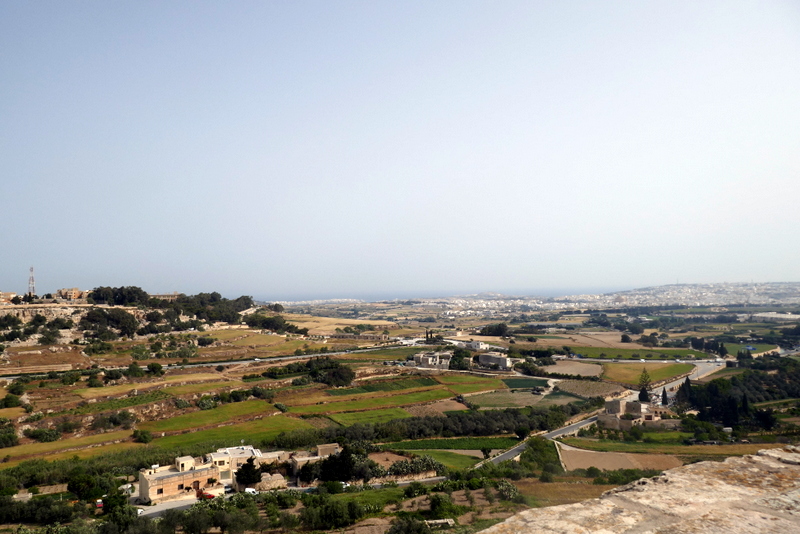
View from the Belvedere overlooking the surrounding
area. Mdina was built on a high point for the best defensive
position.

This side gate was added when the
trains came as a shortcut to get to
the train station. There is a ramp
that leads down to the left.

Typical narrow medieval streets

One branch of the tree grew in a loop.

Is it whimsical or just ugly????

The Prime Minister who was speaking in Maltan. The
crowd clapped and cheered, so I guess they like him.

Inside the Wignacourt Museum.

The main focus of our visit was underground. There is a grotto, a system of WWII air raid shelters, and catacombs, all layered on top of each other.

This is the grotto which was closed off
when too many people were scraping
the flaky limestone off to sell it as
a cure or religious wonder.

Part of the WWII air raid shelter system. They had little
time to build this and it was done by hand, mostly pre-
electricity in Malta, so niches were carved out for oil
lamps. We could see water seepage on the ceilings
as we walked along.

Example of a family room. Mostly
these were used for hours at a time.
The longest use was 2 days of
continuous shelling. Some families
tiled the floors.

This is the remnant of an ancient Roman burial. Nothing
really left to see.

The walkways were all tiny like this
one and curved all over the place.
The map above ground shows that
the catacombs were huge. I got a
bit claustrophobic and left early,
wondering if I would remember the
turns I took to get in. Fortunately,
there was an extensive system of
exit signs!

Back on the bus, we drove toward the coast to another overlook and then the village of Dingli for lunch.

Beyond this little rocky island (which was a lot bigger
until the British used it for target practice) is Tunisia,
hidden by the coastal fog.


Lunch was a yummy rigatoni (big enough for two) followed by a HUGE pork chop with roasted potatoes and veggies. Then we got a demonstration using minced tuna, 'tomato sauce' (which might have been ketchup) and various greens and spices to create the two dishes you see below.


The rest of the day (after 4pm) we were left to our own devices. I contemplated napping, but read and then got to work on email and this blog. More tomorrow????

9/30 -- Weather Objects to the Plan for the Day

 We woke this morning to rain, on the day that we were scheduled to explore Russell, the first capitol of New Zealand, followed by a boat trip in the Bay of Islands out to the Hole in the Rock, a famous landmark that Jim and I bought a painting of in 1999 when we visited for our honeymoon. Rain -- heavy at times -- and winds in the 20s were forecast for the day. 

We took a ferry from Paihia to Russell, which is on an island and only accessible by boat. Rain intercepted us as we landed and made a dash for our small tour bus. I was glad I had my longer rain coat and added my rainpants on the buss. 

We drove slowly past the historic homes on the seashore and learned about the history of Russell. New Zealand was first seen by Europeans when Abel Tasman found it in 1642, but he avoided landing when the beach had hundreds of Maori warriors waiting for him. More than a hundred years later, James Cook landed at a number of locations and the first European settlers  arrived here in Russell in 1814. 

It was a lawless place with brothels and bars and no police force for quite some time. It was populated by whalers, seafarers, escaped Australian convicts

Europeans kept coming and when the French arrived, they slaughtered the indiginous population to the point that the Maori turned to the British for help. The Treaty of Waitangi was signed in English and Maori in 1840. (We will learn more about this treaty tomorrow.) Unfortunately, the two versions did not match. The Maori version said the original peoples would be treated as equals to the English (which frankly is very different from how the English treated every other culture they encountered) while the English version said the Maori were to be subjugated to the English (which is how the English really treated everybody). 

It didn't take long for the Maori to discover that equality wasn't quite what the English had in mind, especially as more English arrivals focused on taking over the trading opportunities that the Maori had seen as their right. 

After our drive along the beach, we headed to Flagstaff Hill, where the English flag had been erected. In 1845, a Maori chief took exception to their treatment by the English and chopped the flag down. The English brought in more soldiers and put it back up. The Maori chief cut it down 3 more times. Each time, more soldiers and another flag arrived. Finally there were 1500 English soldiers, and the chief managed to convince 2 competing tribes to join him and amassed army of 850 warriors who soundly trounced the English and burned the town completely down. Unfortunately for the Maori, this was not the end of the English occupation.

We visited another few locations around the island and returned to our starting point, where Rod announced yet another change to our itinerary. Our cruise to the Hole in the Rock has been cancelled for today because of the high winds and rain storm and rescheduled for tomorrow, which is forecast to be substantially sunnier and less windy and rainy. We grabbed a light lunch at a delicious hole in the wall as we waited for our boat back to the mainland. We also had a bit of wait for the shuttle to the hotel and managed to find a few more gifts.

We returned to our hotel before 2pm and started to work on our blogs (and the bottle of wine purchased this morning). A quiet day is well-appreciated and allowed me to confirm that my note to terminate my lease early and move to Illinois was accepted. It is sunny now (after a brief hail storm earlier) and our boat trip, where I intend to cast a Jim marble into the Hole in the Rock, memorializing our honeymoon here, should be a much more pleasant experience than it would have been today. And it has the advantage of being only 1 day off our 24th anniversary.