Sunday, June 18, 2017

6/18 -- Valley of the Temples, Drive to An Agritoursimo Hotel


Our first stop was Agrigento, a former Greek colony of up to 300,000 people. The main reason for stopping is the ridge line over the valley with the remains of several Greek temples and other ancient structures.  The city of Agrigento was moved in the Byzantine era to higher hills further from the coast.

Carmelina, our local guide, was born in New Jersey, but moved here as a child, so she was very understandable. She showed us photos of how the columns were quarried -- a circle was drawn on the rock and then the slave dug  out around the circle to form a drum. Five drums made up each column. They were built to taper to give the appearance of being taller. The top and bottom of each drum had a hole and lead was used to join them together, sort of like many Ikea products join tall columns today. Carmelina also had a book with overlays to show what we can see now and how things would have  looked when they were new. There is no marble in the area, so the temples were built of sandstone and coated with a marble stucco to make them look like marble. 

The first temple we saw was the Temple of Hera (later Juno when the Romans took over) which has a number of columns still standing.
Temple of Hera above and following 2 photos


This is the exterior alter where public sacrifices were done.

500 year old olive tree
On our way to  the next temple, we walked past the old stone defensive walls that were created by quarrying out the stone where we walked. In the Byzantine era, with the Arabs further up the hill, the  walls were hollowed out into arched spaces that were used for burials. There was also a more common type of Necropolis further on.
Defensive wall
The arches were cut later for graves.
Two marble statues found elsewhere. It is typical for heads and
arms to be removed for new rulers -- sort of like photoshop.
The Temple of Concordia or Peace is the most intact of the temples because in the 5th century AD, it was converted into a Christian church by adding walls between the columns and removing the original statues. It was used for 1700 years. After it was abandoned, an Englishman named Falcone saw the value of it, bought it, and had it restored to as much of its original glory as possible. For a long time, no one had a clue who this temple was dedicated to, but finally some scrap of stone was found documenting Concordia.  It is the most intact of the temples because in the 5th century AD, it was converted into a Christian church by adding walls between the columns and removing the original statues. It was usedfor 1700 years. After it was abandoned, an Englishman named Falcone saw the value of it, bought it, and had it restored to as much of its original glory as possible.

Above and below, view of the Temple of Concordia


A Polish artist created this rendition of Icarus, fallen from the sky.

A girgentana goat, nearly extinct, probably brought by the Arabs.
They have unique spiral horns on both sexes. This young one
will be all white at maturity.
Necropolis
Above and below: The Temple of Hercules
 The last temple had been dedicated to Zeus and was all but rubble. Its construction was unusual because walls were built between the columns and the tops of the walls featured three versions of giants supporting the roof. Zeus had defeated the giants and condemned them to holding the sky up. A collapsed giant has been found, but doesn't look like much any more.
Remains of the Temple of Zeus

Rendering of what it used to look like
Above: Rendering of a fallen giant. Below: w hat you see today.

Looking back at the Temple of Concordia and Agrigento
Finally, it was time for  lunch and we went to a local person's home because of his unusual history. The food was wonderful, the pasta was the best we have had here, and the wine was good, especially considering it came in 2 liter plastic bottles. After lunch, we went down to Marcello's workshop, which featured a small collection of elaborate carts built by his father. He and his son also participated, but the cart-building business died out, so he has a different job. He told us the carts were typically built by 5 people: 2 to carve, 1 to do the iron work, 1 to put all the parts together, and 1 to paint. When the cart painting business died, the painters moved up to restore frescos and similar work, so they were really competent at what they did. The carts were built to size for the beast pulling them and perfected balanced so the weight of the cart only had to be pulled, not supported. Marcello's father was unique because he could do everything but the painting. He had been an orphan and needed  to find a trade by the time he was 14, and became very successful.

Marcello
Marcello deomstrating the balance of the carts

Demonstrating the cart use
Decorative iron work
Decorative woodwork
Old cart -- a plainer one
Jim demonstrates simple woodworking. By
sitting on a board that extends out the back,
he creates the tension needed to hold the
wood in place.
Working with an anvil
Picture of Marcello's father doing each job.
Decorative toy cart
We spent the next hour and a half in siesta on the bus driving to our agritourismo hotel. I had expected something smaller, but this is quite an elaborate hotel with hot tubs (but they were cold), and walking paths, and lots of rooms.
There were lots of stork nests on the top of
electric poles. An old German bunker in
the background. We saw lots of them.
View from our balcony. We had a heavy rainstorm later.
Above and below: the older areas of the hotel. Some of our
group was here, while others, including us, were in the
newer section where we took the balcony photo.

Saturday, June 17, 2017

6/17 -- Salt, Phoenicians, and Wine

We headed north along the coast and stopped in Marsala to go a working salt farm and museum. On our way, Isabella told us about new information (at least new to most of Italy), thanks to the availability of information from outside sources on the internet, about the unification of the country in the 1860s. Garibaldi is treated as a hero in the history books here and is said to have defeated a Sicilian force of 140,000 soldiers (double the peacetime number) with a force of 1,000. In that time, Sicily consisted of the island and most of Italy below Rome and was doing quite well. They had competent rulers and over a million dollars in the banks, all backed by gold. In the north, some of the provinces claimed to have $20 million, but it was all paper and there were bankers in other parts of Europe who looked greedily at the possibility of capturing the Sicilian wealth. They managed to bribe critical Sicilian generals to lay down their arms and basically destroyed much of what the Sicilians had built and killed a high proportion of the population. Sicilians, she said, are not looking to break away, but would like to have the record set straight and not be treated as lesser people by the north ("when a Sicilian counts, he says one, two, three, a lot").

The salt producers are still doing some of the work the old way with lots of back-breaking labor, but they are having a hard time keeping employees, so it is only a question of time until the whole process is mechanized, which will mean the end of their production of the 'flower of salt', the first top layer of salt that is hand skimmed and more interesting than other salts. They use windmills to move the salt water between successive ponds, each shallower and more salty than the last. As the salt concentrates, they use a hand tool to disturb or stir the salt in the ponds. When there is still a bit of water on top of the salt, they use a shovel that is like a fine metal net to lift the top layer of salt and water and let the water drain out before dumping the salt in a basket. When the salt is totally dry, they shovel it into cone shapes and then shovel the cones into wheel barrows to be dumped into a conveyor belt. In the past, they also used a windmill to grind the salt crystals between two huge stones, but that is done by other machines now.
Windmill move the salt water towards shore as salinity increases.


This worker is 'stiring' the salt.


They gave us samples of the flower of salt to taste, and it was very interesting.  They also had several mixes of salt and flavors like lemon or orange or rosemary to use on different kinds of foods. These are all salts you would use at the table, not for cooking.

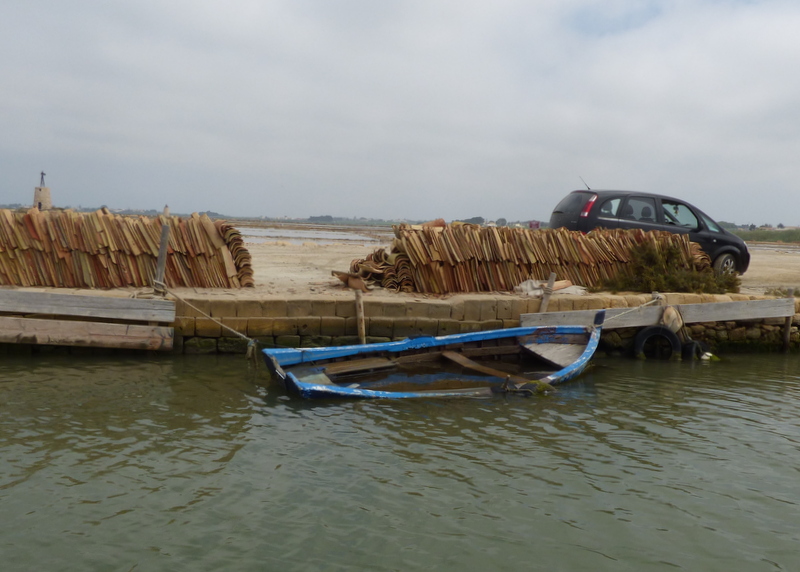
Then we hopped into a shallow draft boat to get to Mothya, and island first populated by the Phoenicians, who were later defeated by the Greeks. The island is in a shallow lagoon created by a long skinny outer island that protects the interior area. The water now is almost 2 feet deeper than it used to be, so some archeological finds are underwater, including the road the Phoenicians built to the mainland. We took the boat up to the old road and  Isabella valiantly jumped out and walked on it - the water was about up to her ankles. She also found a live example of the mollusk that the Phoenicians used to create the purple dye they were famous for.
Ancient walls

That rock is on one side of the submerged causeway.


On the island, we visited a museum that featured a wonderful marble statue and a number of other artifacts from the Phoenician times. Then we walked about a  mile past a couple of digs including an area with simple black  & white mosaic floors as well as what is now believed to have been a temple.
The Youth of Mothya

Reisdence

Mosaic floor

Above and below, two-story watch tower


Temple area

Pond in the temple area

Neighboring island, Scuola. The builing was an insane asylum

Another salt farm on Isola Longa, the barrier island that created
the lagoon we are in.
After a picnic lunch, we headed back to the mainland and continued north to a winery, Baglio Oro. In addition to wine, they also have two jewelry shops, hence the 'oro' (gold) in their name.  In the past, they were primarily growers and then made several white and red wines. However, in the last 5 years, they have also started to produce fine quality marsalas (not like the stuff you cook with). These fortified (hard alcohol added) wines can be dry or sweet. The dry ones need to be aged longer than they have had time for, so the dry one came from another winery. We tried a dry white called Inzolia, a red Nero d'Avola, their new sweet marsala, and a dry marsala. The nero was terrific and we bought a bottle. They also distribute to the San Francisco area, so we gave them our card and their distributor there will let us know where we can find it.  It will be interesting seeing how much it costs at home vs. here in Sicily!

Tomorrow we move to an agritourismo place for a single night's stay. Hard to believe our first week here is almost over!