Thursday, September 21, 2023

9/21 - Fly to Christchurch, Explore Downtown

My computer is giving me no end of trouble trying to insert my  photos in my posts. I select and export my chosen photos to a folder and they act like they are processing but are not where I can find them. I am so far behind on posting that I am going to post without photos and add them later if I can find them. ARGGGGH!   FOUND!!!

We had a fairly leisurely morning and left the hotel at 9:30 to make our way to the Rotorura Airport. On the way, we stopped at a redwood forest. Many years ago, the forestry industry experimented with many different kinds of trees to see what would be the most commercially useful. Redwoods grew well, but quite slowly compared to other varieties. They decided to keep the redwood forest and made it into a public park. The main difference we saw from the redwoods in California was that there weren't any little trees growing at the base of the big trees and no clusters of trees growing up around the 'mom' tree. 


Statues carved from redwood
There is no airport security for internal flights, so we didn't have to segregate toiletries. The one serious limit was a max of 15 lbs for a carry on and a smaller than usual size, which we were prepared for. They didn't actually weigh our carry-ons and Rod had said they don't check the weight of the personal item, so all my electronics were stuffed into my small day bag and probably weighed another 15 lbs. The landing was as scary as any I have had in a long time. Apparently we ran into very windy conditions and the pilots earned their keep trying to keep us aloft long enough to land. Even after landing, we were slewing around. I have never been so glad to get off a plane.

Flying conditions were hazy and my photo
software was only able to improve it a bit.

 
Approaching Christchurch

Our hotel is in the city center and Sandy and I were originally given one king bed. After we got that fixed, we had to rush to meet up for our walk and tram tour around the central city. 

Even 12 years after the horrible earthquake here, there is still a lot of evidence of the damage: some buildings are being rebuilt, many have been torn down and are now empty lots (some of the lots are now park-like), and there are many graffiti-ed buildings that look fine on the outside but apparently too damaged inside for use and are still standing while insurance arguments continue. There are also a lot of new buildings and our hotel is one of them. The city is focused on bringing more residents into the city so there are a ton of apartments and townhouses too.

Our tram tour looped around the downtown area once every 50 minutes and can be used as a hop-on hop-off vehicle, though we started so late that we just stayed on. It was a good overview of the things that are still beautiful and the ones that are works in progress. 


It's cherry blossom time here

The Avon River


Queen Victoria


The city has encouraged painting murals on building yet
to be demolished

Memorial to fallen WWI soldiers

We had dinner at an Irish pub called the Little Fiddle and then walked back to the hotel to finish unpacking.

We also stopped for an ice cream. YUM!!

This is not what it seems  - all paint, not real windows.


Tuesday, September 19, 2023

9/18 - Transfer to Rotorura

 We left the hotel at 8:30 to drive to Rotorua, where we will spend the next 3 nights. As usual, there were a couple of interesting stops on the way so we didn't have to sit all day. The first stop was Hamilton Gardens: a very interesting place with dozens of variations of gardens done over the last 4,000 years and across various cultures and concepts. We viewed a lot of them but it was clear there was not time to see them all. 


This was the entrance to the gardens

This is a series from the Mediterranean Garden


Next we went to the Maori Garden, which featured many structures and statues. Much of it looked wild to represent the 'natural landscape' representative of the time.


The entrance to the actual gardened part

Detail of the small hutch behind the entry fence
Where the regalia of the leaders was kept inside a
kumera (sweet potato) field. They were sensitive to
wet soil and needed more warmth so they were planted
in mounds with the roots pointed to Polynesia. This
kept them both drier and warmer. New Zealand is
colder than the other islands they colonized.


This structure was built to look
like a boat hull.


We walked through an English garden that featured Alice in Wonderland, and then came to an interesting sundial on the ground that could identify months and dates instead of time. I wish I had taken an overview picture of it.

The Surrealist Garden was the weirdest, with oddly shaped trees that had mechanical moving limbs.

My favorite in some ways was the Egyptian Garden, and my reaction to it made me realize that at some level, our trip to Egypt was my favorite. When asked about which of our trips was my favorite, my typical answer is "the one I'm on" but today I realized how much I loved seeing the historic sites in a country whose history I have probably read more about - both fiction and non-fiction - than any other.

 Then we walked through a random sampling of other gardens on the way to finish with the Japanese and Indian Gardens.
This is an English Knot Garden, named for how the
hedges are shaped.

The Japanese garden started with this raked
contemplative area where the raking can represent
wind or water.

This rock is a turtle with the world on its back. The
Japanese garden focused on quiet contemplation
throughout.

This haiku was written as a
reaction to this space.
 

In contrast, the Indian garden is a riot of color designed
to represent a Persian rug. When the growth is complete,
the concept is the plants will all be the same height.
 

Back on the bus, we continued south and made a bathroom stop in Tirau with a dog-shaped tourist building. One section was a sort of a gift shop and I fell in love with a long sweater that was 65% merino lambs wool, 25% possum fur, and 10 % silk. The other find was a heavy fleece jacket with a rounded collar. I figured since I am moving to a colder climate, I could justify both. Possums were brought  here from Australia and now there are more of them in New Zealand than in Australia. Like any non-native animal (especially in a place with no large predatory species), they are a blight on the land and there is a bounty on them. The meat is used for pet food and clothing is made from the fur.

As we approached Rotorura, we stopped at a kiwi breeding facility. Before people came to New Zealand, there were only birds here: no four-legged animals at all. Once mammals were introduced, it had a devastating effect on the bird population, especially the flightless birds. The breeding facility both finds and relocates eggs and has breeding pairs that lay them in the hatchery. Kiwis don't ever imprint on humans so they can be hand raised and released to the wild when they weigh about 2 lbs. We were not allowed to take photos except in an exhibition space with only stuffed birds. 

First we went into a habitat with a couple male birds. They are nocturnal and scare easily, so the lights were all red and we spoke softly if at all. I saw 3 nesting boxes, but no kiwis. Then we moved to the hatchery where there was a newborn kiwi and another starting to try to get out of his egg. The eggs are HUGE: many times the size of a chicken egg. It is hard to see how a chicken sized animal could create it. It would be like a human birthing a 35 lb baby. While we were there, they removed one egg from its box and started to work at gently breaking the egg on one end to facilitate getting the chick out: sort of like a partial cesarean section on the shell.

Next, we moved to the nursery and the bigger brood boxes. Even though the birds are quite territorial, when they are this young, up to 4 birds will share a box. One kiwi last year started getting skinnier instead of gaining weight and they thought he was being bullied, so they moved him to a different box with no change. They finally figured out that he was getting stressed out about the leaves in the box so they were removed. Someplace along the line, as he grew, he became an enormous fan of leaves and started collecting and hoarding them. The center has a sibling egg of his in production and the staff is hoping the brother or sister will be easier to deal with.

This is an accurate representation of the huge egg that
is created by a relatively small bird.
 Usually it is safe to walk in the areas where our hotels are. This time, the pandemic has had lasting and sad effect on the city's population. During the pandemic, the country was completely closed to non-citizens and those here were returned to their home countries. It was also difficult for New Zealanders who were out of the country to get back home. So suddenly, there was next to zero hotel business. There were also concerns about how to  support the homeless population and the presence of a lot of empty motels (here that distinction means to has a kitchen) gave the government the idea to transfer a LOT of the homeless to the empty hotels, focusing on Rotorua because of the number of tourist motels here. Seventeen of them (many near our hotel) are still hosting the homeless, creating a safety problem. Drugs and property destruction are just two of the issues.

Our new hotel is quite old and some of the rooms are apparently more spacious than others. Another clue to the age is the total lack of climate controls in the room outside of remotes to drive the wall-mounted A/C units. We called down to see how to make the room warmer and they immediately offered up space heaters. We opted for extra blankets instead.


Monday, September 18, 2023

9/19 - Learn More About Maori Culture

Today, we visited a couple of Maori sites to learn more about their lives and culture. 

Our first stop was a Marae (meeting place) where we got an introduction to the area we were visiting. It became the largest fir tree plantation in the Southern Hemisphere because the volcanic impact on the soil created an ideal environment for the trees. Species that typically take 70 years to reach maturity in normal circumstances are fully ready to harvest here in 25-28 years. However, problems arose because of how the British Government (The Crown) approached the question of land ownership. Their contention apparently was since the Maori had no paper documentation that they owned the land, it could be claimed and documented by anyone else. This is a ridiculous but typical argument by interlopers when they encounter cultures who don't see land as something to 'own' but as something that is shared by all. The Maori finally won the right to the land, but The Crown owns the trees and the revenue from leasing the land to timber companies, which amounts to millions (if not billions over the years) of dollars.

After our initial introduction, we moved to the Marae where there is a meeting house and went through a welcoming ritual. The women were at the front of the group, followed by the men. One woman opened the ritual by calling out to women by the meeting room and there was a series of song exchanges before we started moving forward. When we reached a area with chairs set up, the men were seated in the front (to protect us) and the women in back.Then an older Maori man began a long oration in Maori, and finally we moved into the meeting room (after removing our shoes) with the men in front again and listened to the gentlemen tell us more about the Maori experience and culture. 

 The traditional Maori greeting called hongi.
This action of touching heads and noses recalls
the actions of the gods breathing life into
the first woman and changes you from a
stranger to one of the people of the land.
 

Interestingly, when someone dies, their body is prepared with water from the river (in the old days, they would be washed IN the river, but this is no longer considered acceptable) and then transferred to a special mat in the meeting room through a window, as only the living use doors. After three days of visitation, the body is buried. Photos of the departed are hung on the walls. The people told us that the call to join brings in not only the living but also the departed spirits, so there is a real sense of the departed always being there too.

Inside the Marae. Photos are of the deceased

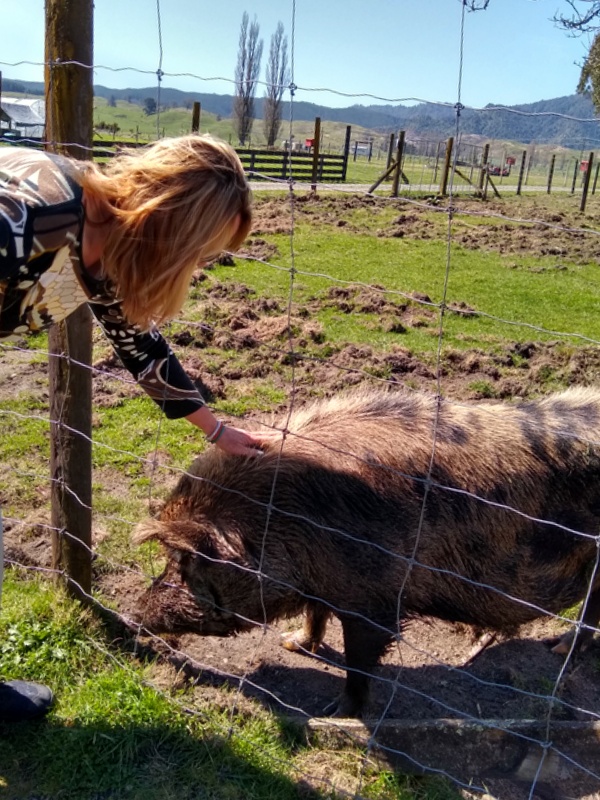
Next we put our shoes back on and moved to a room with snacks and tea or coffee for general conversation. When that was done, we took the bus to an area by a river where we were treated to a hangi: a meal cooked on hot rocks in the ground. We had an opportunity to visit some of the animals there too. The deer was quite stand-offish, but the horse, two very furry pigs, and a jealous goat were glad  to see us. Sandy especially liked the bigger furry pig and gave her(?) quite the backrub. 


We also had time to enjoy the view of the black swans on the river. I had managed to misplace my long range camera at the Kiwi Exhibit, so my photos for the day were limited to  what  I could capture my phone. Fortunately, I was re-united with my camera back at the hotel.


Then it was time to uncover the hangi pit, which was covered with a lot of sand and several layers of cloth and a squarish metal top. The vegetables and meat were in three tiers over the hot rocks. Lunch consisted of roast pork, roast chicken, potatoes, kumara (a special New Zealand variety of sweet potato), stuffing, coleslaw, and salad. We were also served fry bread at the table. It was all quite tasty and filling. Sandy and I agreed that dinner was probably not going to be necessary.


Before we left, our guide performed a haka (without the tongue display - apparently that's for men only) and we learned more about the group that provided the tour. They support the local population in a number of ways. They can apply each year for awards in four categories. Last year, they applied for all 4 and were accepted to compete in three and won one. 


Text of Haka in Maori

Literal and Intended Meanings
 

Then it was time for the drive home and I dozed a bit -- still trying to catch up after being an hour or two shorter on  sleep than normal, despite having one of my best sleeps today. I collected my camera and Sandy headed off for a thermal pool experience while I am in catch-up mode on the blog and spending. Her thermal pool experience involved dips in alternating and increasingly intense warm and cold pools. I am SO glad I skipped it.


Sunday, September 17, 2023

9/17 Explore Waiheke Island

Today we took a ferry to Waiheke Island, one of the largest off New Zealand, and home to 10,000 people. We got a bus tour of the island narrated by Neil (also the driver) and had both a wine tasting/tapas and an olive oil tasting.

Our ferry was quite early, so we stopped in the main town of Oneroa for 30 minutes where Sandy and I stumbled on to a shop selling creative styles of clothing made from Merino wool. Both Sandy and I loved the styles and the colors and she found a jacket she loved and I got 3 colorful pair of Merino wool sox. 

Then we took off for a scenic tour of the island. Lots of houses ranging from simple to elaborate and many beaches defined the island. Water access is a challenge here and rain catchment and storage tanks are the primary ways to maintain adequate supplies. If you run out, it costs $300NZ to half fill a tank, which lasts a couple months. Because of this, homes, no matter what size, are limited to 2 bedrooms.


When we reached Casita Miro, the mosaic walls, designed and created by the owner, were immediately noticeable. He has retired from running the winery and has been building his walls for 10 or more years.We sampled 5 wines and later got a wonderful selection of tapas. The wine, unfortunately, was not impressive. The Pinot Gris was my favorite, but not so notable that I was willing to buy any. After our tasting and tapas, we wandered around a bit, admiring the mosaics.

Old Cork Tree

Our tasting flight and lunch menu


Then it was back on the bus for the trip to the olive oil tasting. They are in the process of updating their plant and tasting room elsewhere on the island, so in this temporary location, we saw a video of the oil creation process, then tried 6 of their oils. The first 5 tasted good, but pretty much the same. The last one was punchier, but because of that, less generically useful. I did buy 3 small bottles of the one I liked best.

On our way back to the ferry, there was a little more time for sight seeing. 


Back in Auckland, we started prepping for our move to Rotarura tomorrow, then went to dinner with some of the group to the Occidental, a long-time pub famous for its mussels. Sandy got some local green-lipped mussels while I opted for fish and chips. Then it was back to the hotel for more end-of-stay prep.